
How to Brew White Tea: The Ultimate Guide to Temperature and Steeping
White tea is often misunderstood by casual drinkers who mistake its subtlety for a lack of flavor. As the least processed of all tea varieties, it retains the natural characteristics of the fresh tea leaf, offering a profile that ranges from delicate floral notes to hay, honey, and melon. However, this delicacy makes it unforgiving if prepared incorrectly. Many enthusiasts unknowingly ruin their experience by using boiling water or improper steeping times, resulting in a brew that is either flat and tasteless or unexpectedly bitter. To truly appreciate the complexity of white tea, one must approach the brewing process with precision and patience. This guide explores the essential variables of temperature and time, helping you unlock the full aromatic potential of these fragile leaves.
Why white tea requires a gentle touch
To understand how to brew this beverage, you must first understand what it physically is. Unlike black tea, which is fully oxidized, or green tea, which is usually fired or steamed to stop oxidation, white tea is simply withered and dried. This minimal processing preserves the delicate trichomes, the silvery-white hairs found on the buds, which give the tea its name and its characteristic texture. Because the cellular structure of the leaf has not been broken down by rolling or crushing, the release of flavor compounds is slower and more subtle.
This structural integrity presents a unique challenge. If you treat it like a robust black tea, you risk cooking the leaves, destroying the nuanced antioxidants and volatile oils that provide the aroma. Conversely, because the leaves are often voluminous and fluffy, particularly varieties like Silver Needle (Bai Hao Yinzhen) or White Peony (Bai Mu Tan), using too little leaf or water that is too cool will result in a cup that tastes like nothing more than hot water. The goal is to find a balance where the heat is sufficient to extract flavor without scorching the tender buds.
Mastering water temperature
The single most significant error in brewing white tea is the use of boiling water. Water at 212°F (100°C) strips the leaves of their delicate sweetness and brings forward astringent tannins that overpower the cup. However, the common advice to use very cool water is also misleading. If the water is too cold, the extraction remains incomplete, leaving the best floral notes trapped inside the leaf.
The ideal temperature range generally falls between 175°F and 185°F (80°C to 85°C). The specific temperature often depends on the leaf grade. Bud-heavy teas like Silver Needle generally require slightly higher temperatures within that range to penetrate the dense buds, while leafy varieties like White Peony release flavor more easily and can tolerate the lower end of the spectrum. It is also vital to use filtered water; mineral-heavy hard water can mask the tea’s naturally soft mouthfeel.
Here is a breakdown of optimal parameters based on the style of white tea:
| Tea variety | Primary characteristic | Ideal temp (°F) | Ideal temp (°C) |
|---|---|---|---|
| Silver Needle | Pure buds, dense, subtle | 180°F – 185°F | 82°C – 85°C |
| White Peony | Bud and two leaves, fuller body | 175°F – 180°F | 79°C – 82°C |
| Shou Mei | Mature leaves, darker, bolder | 185°F – 190°F | 85°C – 88°C |
Using a variable temperature kettle is the easiest way to achieve these results. If you do not have one, bring water to a boil and let it sit with the lid open for approximately five to seven minutes before pouring.
Vessels and steeping duration
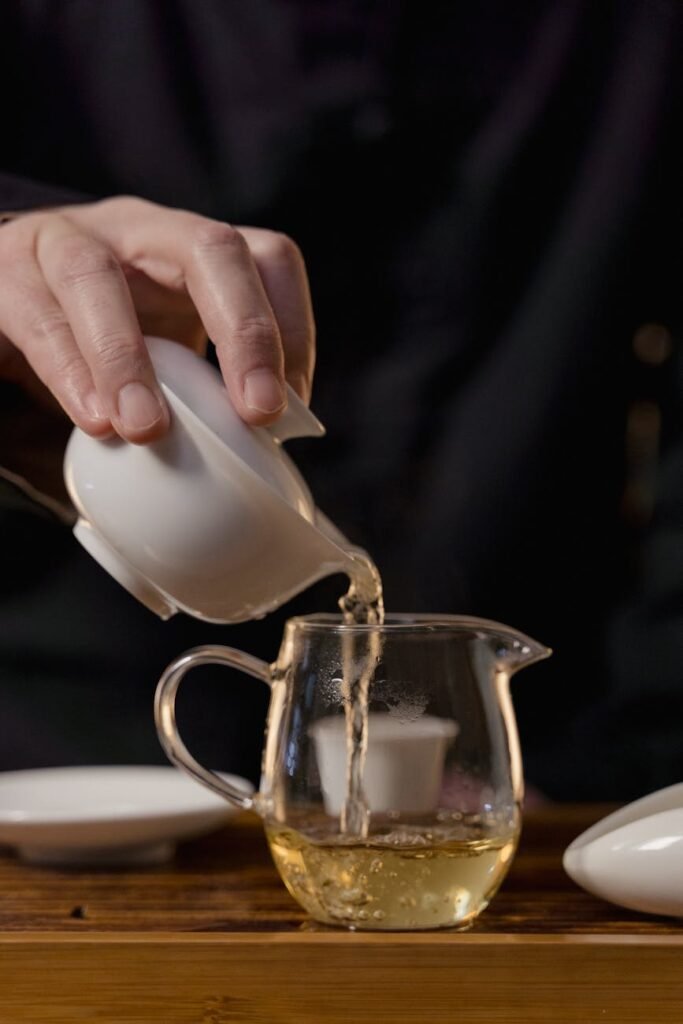
Once you have controlled the heat, the next variable is time. White tea is incredibly versatile regarding brewing vessels, but glass and porcelain are generally preferred over porous clays. A glass teapot is a favorite among enthusiasts because it allows you to watch the “dance of the leaves” as they rehydrate and float vertically, a visual hallmark of high-quality white tea. Porcelain, such as a gaiwan, is excellent for neutral brewing that does not alter the flavor profile.
The duration of the steep is directly related to your leaf-to-water ratio. For a standard “Western style” brew in a mug or teapot, you want a longer steep time to draw out the flavor. This typically involves using about one tablespoon of leaves per 8 ounces of water and steeping for 3 to 5 minutes. White tea is forgiving; if you leave it for an extra minute, it rarely becomes undrinkable, unlike green tea.
However, for a more intense experience, many adopt the “Gongfu style.” This method uses a much higher ratio of leaves to water but involves very short steeps, starting at just 20 to 30 seconds and increasing by 10 seconds for each subsequent infusion. This approach highlights the evolution of the flavor, revealing how the taste shifts from fresh hay to sweet nectar over several cups. Because white tea leaves are bulky, ensure your vessel is large enough to allow them to expand fully.
The step-by-step brewing ritual
Combining the elements of temperature, vessel, and time creates a ritual that guarantees a perfect cup. Start by pre-warming your teapot or cup with hot water. This step is often skipped, but it is crucial; pouring temperature-controlled water into a cold vessel instantly drops the temperature, potentially falling below the range needed for proper extraction. Discard the warming water before adding your leaves.
Measure your tea generously. Because white tea is so light and airy, measuring by weight (2 to 3 grams per cup) is far more accurate than measuring by volume. If you must use a spoon, do not be afraid to heap it. Place the leaves in the warm vessel and take a moment to smell them; the heat from the porcelain will release a preview of the tea’s aroma.
Pour your water gently over the leaves. Avoid pouring directly onto the delicate buds with force; instead, let the water slide down the side of the vessel to swirl the leaves gently. Cover the vessel to retain heat and aroma. After the designated time, decant the tea fully. Do not leave the leaves soaking in a small amount of water, as this will make the second steep bitter. White tea is famous for its longevity and can often be re-steeped three to four times, with the flavor profile becoming sweeter and “thicker” in later infusions.
Conclusion
Mastering the art of brewing white tea transforms a simple beverage into a sophisticated sensory experience. Throughout this guide, we have established that the minimal processing of white tea demands a respectful approach to temperature, ideally keeping water between 175°F and 185°F to preserve the antioxidants and delicate flavor compounds. We also explored how the choice of vessel and the duration of steeping can alter the strength and body of the liquor, emphasizing the importance of allowing the voluminous leaves ample room to expand. By avoiding boiling water and adjusting your timing based on the specific variety—whether it is the subtle Silver Needle or the bolder Shou Mei—you can eliminate bitterness and unlock the natural sweetness characteristic of this tea category. Ultimately, while these guidelines provide a solid foundation, the perfect cup is a matter of personal preference, so feel free to experiment within these parameters to find your ideal brew.
Image by: Tima Miroshnichenko
https://www.pexels.com/@tima-miroshnichenko